Knee Gives Way Suddenly? 7 Clues That May Explain Why Your Knee Feels Unstable
Knee Gives Way Suddenly? 7 Clues That May Explain Why Your Knee Feels Unstable
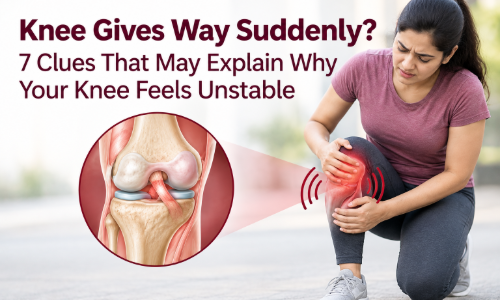
The Split Second That Makes You Lose Confidence in Your Knee
You are walking normally. Then, without warning, your knee dips.
Perhaps it happens while stepping off a kerb. Perhaps your leg feels unreliable as you rise from a chair. Or maybe your knee suddenly bends when you are coming downstairs, forcing you to grab the railing.
You recover your balance, take a few more steps and wonder whether anything serious has happened.
This experience is commonly described as knee buckling or a giving-way sensation. It can occur with or without pain, and it does not always mean the knee has sustained a major injury.
However, when the episode happens repeatedly, it raises an important question: why is the knee struggling to support and control movement?
The answer may lie in the muscles, ligaments, cartilage, joint mechanics or even the way the nervous system coordinates movement.
Understanding the pattern behind the symptom is the first step towards identifying what may be happening.
The 60-Second Guide: What Does Your Knee Instability Look Like?
Different people experience knee buckling in different ways. The details surrounding the episode can provide useful clues.
|
What you notice |
What it may indicate |
|
Your knee gives way after twisting it during sport |
A ligament or meniscus injury may need to be considered |
|
Your knee dips while climbing or descending stairs |
Muscle weakness, pain or altered joint mechanics may contribute |
|
Your knee feels unreliable after prolonged sitting |
Stiffness, muscle control or an underlying joint problem may be involved |
|
Your knee buckles when pain suddenly occurs |
Pain may temporarily interfere with muscle control |
|
Your knee gives way repeatedly without obvious pain |
Joint instability, muscle weakness, balance problems or another cause may be involved |
|
Your knee buckles and becomes swollen after an injury |
An internal joint injury may need to be evaluated |
These are clues, not diagnoses. Several conditions can produce similar symptoms, so the pattern alone cannot confirm the underlying problem.
Seven Possible Reasons Your Knee May Be Giving Way
1. A ligament may not be providing enough stability
Imagine planting one foot firmly on the ground and turning your body in another direction. This is a common movement in football, badminton, basketball and other sports.
If the knee twists unexpectedly, the ligaments that help control joint movement may be injured.
The anterior cruciate ligament (ACL) is one such structure. Other ligaments can also be affected, depending on the direction and force of the movement.
Possible accompanying signs include:
- A popping sensation at the time of injury.
- Swelling developing after the incident.
- Difficulty changing direction or trusting the affected leg.
- A feeling that the knee shifts or gives way during movement.
An ACL injury is not the only explanation for these symptoms. A clinical examination is needed to distinguish between possible causes.
2. The meniscus may be affecting normal movement
Inside the knee are two crescent-shaped structures called menisci. They help distribute loads across the joint and contribute to its normal function.
A meniscus can tear following a twisting injury. Tears may also occur as the tissue changes with age.
Some people notice pain along one side of the knee, swelling, catching or difficulty fully bending or straightening the leg.
When movement becomes painful or restricted, the knee may feel unreliable. Not every meniscus tear causes buckling, and a giving-way sensation does not establish that a tear is present.
A knee that becomes mechanically locked or cannot be straightened after an injury requires prompt medical assessment.
3. The quadriceps may not be controlling the knee effectively
The quadriceps are the large muscles at the front of the thigh. They help straighten the knee and control movement when the leg bears weight.
Descending stairs places particular demands on these muscles because they must control the body's movement as the knee bends.
If the quadriceps are weak, fatigued or inhibited by pain, the knee may feel as though it is dipping unexpectedly.
This can occur after an injury, a period of reduced activity or a painful knee condition.
The important distinction is that muscle weakness is one possible explanation—not something that should automatically be assumed whenever the knee buckles.
4. Pain may interrupt the muscles' normal response
Sometimes the sequence is different: the pain comes first, and the knee buckles immediately afterwards.
For example, a sudden sharp sensation inside the knee while stepping down may interrupt the normal contraction of the surrounding muscles.
This is known as pain-related muscle inhibition. It can make the leg feel temporarily unable to support body weight.
Pain-related buckling can occur in several knee conditions. However, the same symptom may also accompany structural injuries, so the timing of pain is useful information rather than proof of a particular diagnosis.
5. Osteoarthritis may be contributing to instability
Osteoarthritis affects the tissues within a joint and may involve cartilage changes, underlying bone changes, stiffness and pain.
When the knee is affected, everyday activities such as standing up, walking on uneven surfaces or using stairs may become more difficult.
Some people with knee osteoarthritis describe episodes in which the joint seems to dip or give way.
Possible contributing factors include reduced quadriceps strength, pain-related muscle inhibition and changes in the way the joint moves.
Nevertheless, a knee that buckles does not automatically mean that arthritis is present or that it has reached an advanced stage.
6. Reduced conditioning may be affecting joint control
Muscle strength and movement control can decline during periods of inactivity.
For example, someone who reduces walking for several weeks because of discomfort may find that standing up, climbing stairs or returning to exercise feels more difficult.
Reduced conditioning can affect the muscles around the knee and hip, which contribute to lower-limb control.
This may be one factor behind instability, but it is not a sufficient explanation for every episode. Sudden buckling, particularly after an injury, should not be attributed to inactivity without considering other causes.
7. The problem may not be limited to the knee joint
Not every giving-way episode originates from damaged structures inside the knee.
Problems affecting balance, muscle activation or nerve function can sometimes make a leg feel weak or unreliable.
The distinction becomes particularly important when buckling occurs without clear knee pain or swelling, or when it is accompanied by numbness, altered sensation, weakness elsewhere in the leg or repeated falls.
These symptoms may require assessment beyond the knee itself.
When Is Knee Buckling More Than an Inconvenience?
A single episode after an awkward movement is different from a knee that repeatedly collapses during ordinary activities.
Seek urgent medical attention if:
- You cannot bear weight after a knee injury.
- The knee becomes severely swollen soon after an injury.
- The joint appears deformed.
- You cannot move or straighten the knee after an injury.
- The knee is hot, red and markedly swollen, particularly with fever.
- You develop sudden weakness or loss of sensation, especially with a cold, pale or unusually numb foot following an injury.
Arrange a clinical assessment if:
- The knee repeatedly gives way.
- You have experienced a fall or near-fall.
- Instability is interfering with walking or stair use.
- Pain, swelling, catching or restricted movement keeps returning.
- You have lost confidence in the knee during everyday activities.
Repeated buckling can increase the risk of falling and sustaining another injury. Waiting for severe pain to develop is not a reliable way to judge whether the problem matters.
What Happens During an Assessment for Knee Instability?
There is no single test that identifies every cause of knee buckling. The evaluation usually combines the history of the symptoms with a physical examination and, when appropriate, imaging.
First: Reconstruct the episode
The clinician may ask about the first occurrence, the movement involved, the presence of pain or swelling, previous injuries and the activities that now trigger instability.
Whether the knee gives way during a twist, while descending stairs or without any obvious trigger can help narrow the possible explanations.
Next: Examine how the knee moves
The examination may include an assessment of:
- Knee movement and swelling.
- Tenderness around the joint.
- Quadriceps and other muscle strength.
- Ligament stability.
- Walking pattern and functional movement.
- Balance or neurological function when relevant.
The hip and ankle may also need consideration because movement across the lower limb is interconnected.
Finally: Determine whether imaging is useful
The choice of investigation depends on the suspected cause.
X-rays may help identify fractures, alignment changes and features associated with osteoarthritis.
MRI may be useful when a ligament, meniscus or other soft-tissue injury is suspected.
Additional investigations may be appropriate if the symptoms suggest a cause outside the knee joint.
An MRI is not automatically necessary for every person whose knee gives way. The purpose of imaging is to answer a specific clinical question.
What Should You Do Between the Episode and Your Assessment?
The immediate priority is to avoid another collapse and protect the knee from further injury.
Stop and stabilise. Stop the activity, sit somewhere safe and avoid testing the knee repeatedly.
Avoid movements that trigger buckling. Running, rapid turns and unsupported stair use may be unsafe if the knee feels unreliable.
Do not force weight-bearing. If you cannot bear weight after an injury, seek urgent assessment rather than trying to walk it off.
Manage discomfort cautiously. If swelling is present, a cold pack wrapped in a towel may provide short-term relief. Avoid applying ice directly to the skin.
Keep track of the pattern. Record when the episode occurred, what movement triggered it, whether pain appeared first and whether swelling followed.
Do not begin aggressive strengthening blindly. Exercise may be helpful for certain causes of instability, but the appropriate movements depend on the underlying problem. Stop any exercise that causes the knee to buckle or produces significant pain.
Can You Reduce the Risk of Future Episodes?
Prevention depends on what is causing the knee to give way. There is no universal exercise or routine that prevents all forms of instability.
Several measures may nevertheless support knee function when appropriate:
- Progressive strengthening: Building the strength of the quadriceps, hamstrings and supporting hip muscles may improve movement control.
- Balance training: Appropriate balance exercises can help when coordination is a contributing factor.
- Gradual return to activity: Increase training volume and intensity progressively rather than making abrupt changes.
- Sport-specific conditioning: Suitable preparation and movement technique may help reduce certain sports injury risks.
- Attention to recurring symptoms: Repeated buckling, swelling or pain warrants assessment rather than simply being managed by avoiding movement indefinitely.
The right approach depends on the diagnosis, current function and any restrictions associated with an injury.
Knee Instability in Bengaluru: Recognising the Everyday Triggers
Knee buckling does not happen only on a sports field. In Bengaluru, the symptom may become noticeable during ordinary routines.
An office worker may experience it when standing after prolonged sitting. Someone commuting by bus may notice it while stepping up or down. A recreational badminton player may experience instability during a sudden change of direction. An older adult may find that uneven pavements make walking feel less secure.
These situations place different demands on the knee, but the symptom deserves the same careful consideration.
For individuals seeking an orthopaedic assessment for knee instability in Bengaluru, the important first step is to understand the nature of the problem rather than assume that every episode has the same cause.
Dr. Nataraj H.M. works in orthopaedics, with clinical focus areas including knee and shoulder conditions, sports injuries, ligament injuries, arthroscopy and joint replacement.
The evaluation of a giving-way knee depends on the individual's symptoms, examination findings and relevant investigations.
Frequently Asked Questions
1. Why does my knee suddenly give way while walking?
Knee buckling may be associated with quadriceps weakness, pain-related muscle inhibition, ligament injury, meniscus damage, osteoarthritis or problems affecting balance and nerve function. The circumstances and accompanying symptoms help determine which causes need consideration.
2. Can a knee give way without pain?
Yes. Instability can occur without significant pain. Possible explanations include ligament-related instability, reduced muscle control or other problems affecting balance and movement. Repeated episodes, particularly those causing falls, deserve assessment.
3. Is knee buckling always a sign of an ACL tear?
No. An ACL injury is one possible cause, particularly after a twisting injury or sudden change of direction. Muscle weakness, meniscus problems, osteoarthritis and other conditions can produce similar sensations.
4. Why does my knee buckle when going downstairs?
Descending stairs requires controlled knee bending while supporting body weight. Weakness of the quadriceps, pain, stiffness or joint instability may interfere with this process.
5. Can knee osteoarthritis cause the knee to give way?
Yes. Osteoarthritis may contribute through pain, reduced muscle strength and altered joint mechanics. However, not every episode of knee buckling is caused by arthritis.
6. Can a meniscus tear make my knee unstable?
A meniscus tear can cause pain, swelling, catching and restricted movement, which may make the knee feel unreliable. However, not all meniscus tears cause buckling, and other conditions may produce similar symptoms.
7. Which scan is used for a knee that keeps giving way?
The appropriate investigation depends on the suspected cause. X-rays may help assess bones and arthritic changes, while MRI may be useful for suspected ligament or meniscus injuries. Not everyone requires the same imaging.
8. Can exercises prevent knee buckling?
Strengthening and balance exercises may help when weakness or reduced coordination contributes to instability. They may not address a significant structural injury or another underlying cause. Exercise selection should reflect the individual's condition and functional ability.
9. When should I seek help for knee instability in Bengaluru?
Consider an assessment if buckling recurs, walking becomes unreliable or the knee develops persistent pain, swelling or restricted movement. Inability to bear weight after an injury, deformity or other urgent warning signs requires prompt medical attention.
The Final Point: A Stable Knee Begins With Understanding the Symptom
A knee that gives way is communicating a problem with movement, muscle control or joint stability. The reason may be relatively straightforward, or it may involve an injury that needs closer evaluation.
The most useful clues are often found in the details: what you were doing, whether pain came first, how quickly swelling appeared and whether the episode keeps recurring.
Do not judge the seriousness of knee instability by pain alone. A knee that repeatedly collapses can affect safety and mobility even when discomfort is limited.
Understanding why the knee is giving way is a more useful starting point than assuming it is simply weak, stiff or part of getting older.